
The Spec Comparison at a Glance
Spec | Dock 4 | Dock 3 |
|---|---|---|
Compatible aircraft | Matrice 5TD | Matrice 4D, Matrice 4TD |
Total weight | 66kg (batteries and aircraft not included) | 55kg (aircraft not included) |
Dimensions, cover open (L×W×H) | 1750×640×550mm | 1760×745×485mm |
Dimensions, cover closed (L×W×H) | 639×640×836mm | 640×745×770mm |
Input power | Up to 2,000W | Up to 800W |
Operating temperature | -40°C to 50°C | -30°C to 50°C |
IP rating | IP56 | IP56 |
Max landing wind speed | 12 m/s | 12 m/s |
Max operating altitude | 5000m | 4500m |
Charging method | Battery swap + wireless backup | Wireless charging |
Battery swap time | Under 25 seconds | Not supported |
Operational turnaround | Under 45 seconds | Not supported |
Charging time (15% to 95%) | 27 minutes | 27 minutes |
Max batteries held | 3, across 4 compartments | Built-in only |
RTK base station | Via DJI O4 Ground Station | Built into the dock |
Video transmission | DJI O4 Enterprise Enhanced | DJI O4+ Enterprise |
Battery-Swap Charging Replaces the Wait
A swap triggers only when the difference between the depleted battery and the highest-charged one exceeds 10% and that highest battery sits above 90%, timed to the aircraft landing, before a scheduled operation starts, or an hour ahead of an automated mission. Dock 3 has no equivalent, every aircraft charges in place on a 27-minute cycle regardless of how the dock is deployed. Dock 4 holds three batteries across four compartments and charges two from separate sets simultaneously, so the swap stock replenishes in the background between flights rather than tying up the only charging slot.

RTK Has Moved to the O4 Ground Station
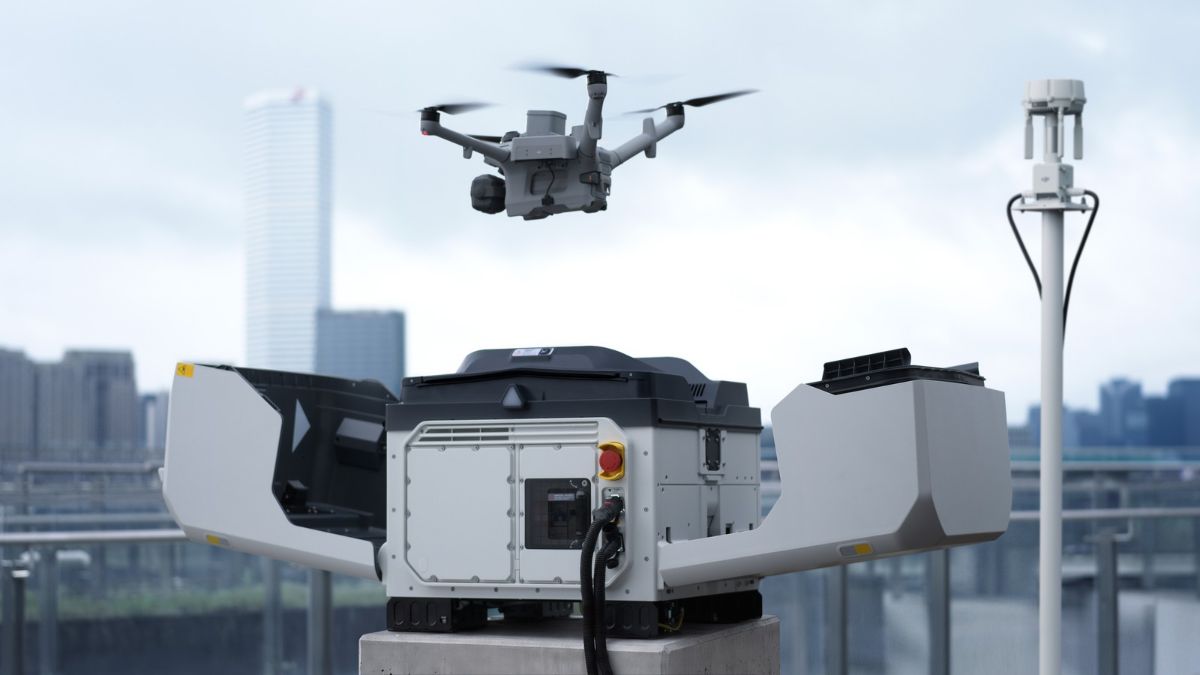
Dock 3 carries its RTK base station built into the dock housing itself. Dock 4 moves that function out to a separate DJI O4 Ground Station, extending transmission range to 40km and running four connection modes, including a roaming mode that adds a second O4 to extend coverage without the dock needing to sit inside direct range. This is an architecture change rather than a feature removed, and it adds a physical component to the installation a Dock 3 site doesn't need to plan for.
Power and Installation Requirements Have Grown
Dock 4 needs up to 2,000W of input power against Dock 3's 800W, a real factor on a site where the existing circuit was sized for the older dock. The power cable connector has also changed (LP25 against Dock 3's LP20), so Dock 3 power cabling isn't compatible with a Dock 4 installation even where the physical mounting base is reused. Total unit weight runs higher too, 66kg against 55kg, before batteries or the aircraft are factored in.
Environmental Tolerance Favours the Dock 4
Operating temperature extends to -40°C against Dock 3's -30°C, and maximum operating altitude rises to 5000m against 4500m. Both docks hold the same IP56 rating and the same 12 m/s maximum landing wind speed, so the gap is specifically about cold-weather and high-altitude deployment rather than weatherproofing generally.
Aircraft Pairing Is Not Interchangeable
Dock 4 pairs exclusively with the Matrice 5TD, which carries 59 minutes of maximum flight time against the Matrice 4TD's 54, a thermal camera at double the native resolution, and a parachute fitted as standard on the UK and EU airframe. Moving from a Dock 3 setup to a Dock 4 setup means buying the new dock and the Matrice 5TD together, not adding a payload or a firmware update to existing hardware.
What Actually Changes Between the Two
The swap-versus-charge difference matters most on a high-tempo deployment, repeat perimeter patrol, first-responder dispatch or multi-sortie corridor inspection, where a 27-minute wait between flights is the limiting factor. A site with lower available input power, or one that's already invested in Dock 3 and Matrice 4TD hardware with no need for faster turnaround, has no obligation to move. The decision sits on operational tempo and site electrical capacity more than on any single spec in isolation.
DJI's own installation guidance notes mass-production mounting hole positions are shared across the range, though the power cabling (LP25 against LP20) isn't compatible and needs replacing regardless.
No. Dock 4 pairs exclusively with the Matrice 5TD.
Up to 2,000W against Dock 3's 800W, worth checking against the site's existing circuit before ordering.