Drones for TV and Film
Aerial and ground cinematography, from full-frame 8K to FPV
A shot that used to need a crane, a track and half a day now needs an aircraft and a battery. More usefully, it needs one that matches the colour of the camera already on the floor, so the aerial plate cuts against the ground coverage without a fight in the grade.
AERIAL CINEMATOGRAPHY
The platforms that make the plate
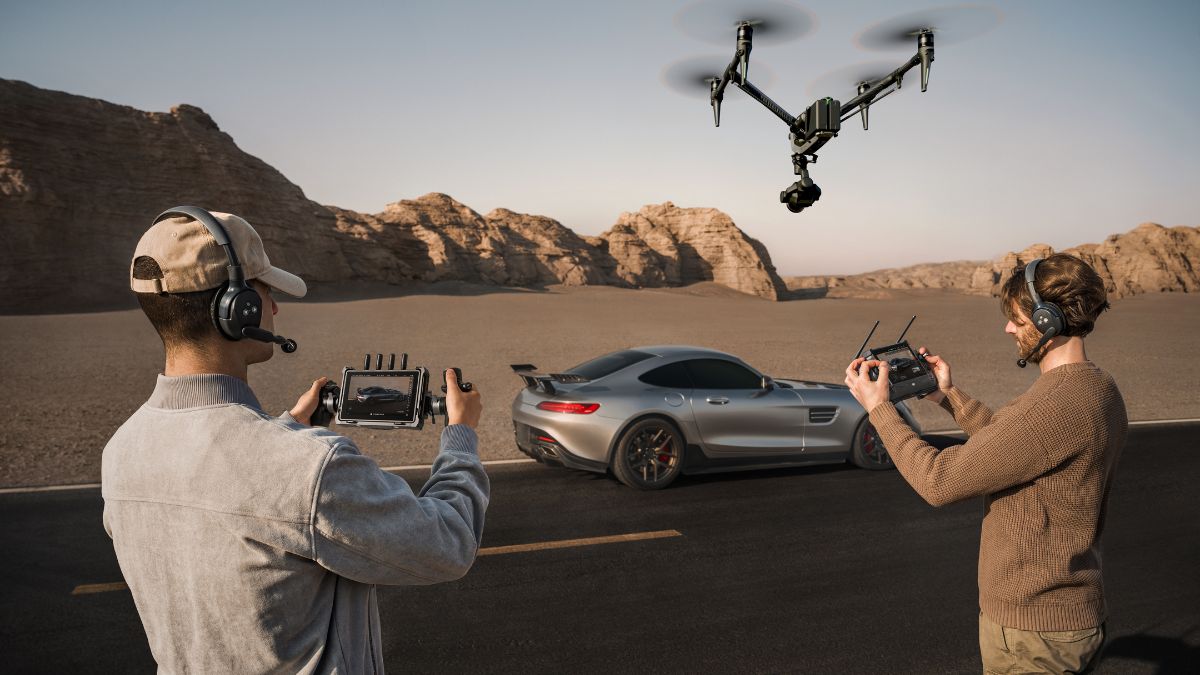
The DJI Inspire 3 is the aerial unit for productions where the plate has to hold up next to a cinema camera. Its X9-8K Air records 8K CinemaDNG through a full-frame sensor at 516 g, roughly half the weight of the Ronin 4D's X9 body, which is what allows the airframe to stay manoeuvrable while carrying it.
Five DL mount full-frame primes cover 18 mm through to telephoto, each built for aerial work rather than adapted for it. The transformable airframe supports 360° pan and, with the landing gear lowered, an unobstructed 80° upward angle, which puts the camera in positions no conventional gimbal reaches.
For productions where a full Inspire build is more than the schedule or budget supports, the DJI Mavic 4 Pro carries a 100 MP 4/3 Hasselblad recording 6K/60fps HDR at up to 15.5 stops, with dual telephoto cameras reaching 168 mm. Its Infinity Gimbal rotates a full 360° and shoots up to 70° upward. The DJI Mavic 3 Pro remains a strong triple-camera option where three focal lengths from one aircraft suits the coverage.
- Capture 8K CinemaDNG plates with the latitude to reframe and grade in post
- Match aerial colour to ground cameras through DCCS rather than fixing it in the grade
- Reach compositions a crane or conventional gimbal cannot physically achieve
- Deploy a Mavic 4 Pro where the schedule cannot carry a full Inspire build
- Repeat a move exactly for a second take or a VFX plate pass
GROUND AND STABILISATION
Matching the air to the floor
Aerial is one unit on a production, and the argument for buying into one ecosystem is that the rest of the coverage matches it.
The DJI Ronin 4D combines a full-frame Zenmuse X9 gimbal camera, four-axis stabilisation, LiDAR focusing and wireless transmission in a single body. Stabilisation, focus, monitoring and transmission are built in rather than assembled, which removes the rigging time a conventional cinema build demands before a frame is shot. CineCore 3.0 records internally in Apple ProRes RAW, ProRes 4444 XQ, ProRes 422 HQ, ProRes 422 LT and H.264 at up to 8K/75fps and 4K/120fps, holding 14+ stops of dynamic range.
The DJI RS 4 Series covers handheld stabilisation across mirrorless and cinema bodies, with the RS 4 Mini for lighter builds and the Ronin 2 Professional Combo for heavier configurations. DJI Master Wheels give a gimbal operator wheel control on both the Ronin 2 and the Inspire 3, so the same operator works the same way whether the camera is in the air or on the floor.
- Match air and ground colour within one system rather than reconciling two
- Reduce rigging time with stabilisation, focus and transmission integrated
- Record ProRes RAW internally at up to 8K/75fps
- Operate with the same wheel controls across aerial and ground units
- Scale from RS 4 Mini through to Ronin 2 as the build demands
FPV
Moves nothing else can make
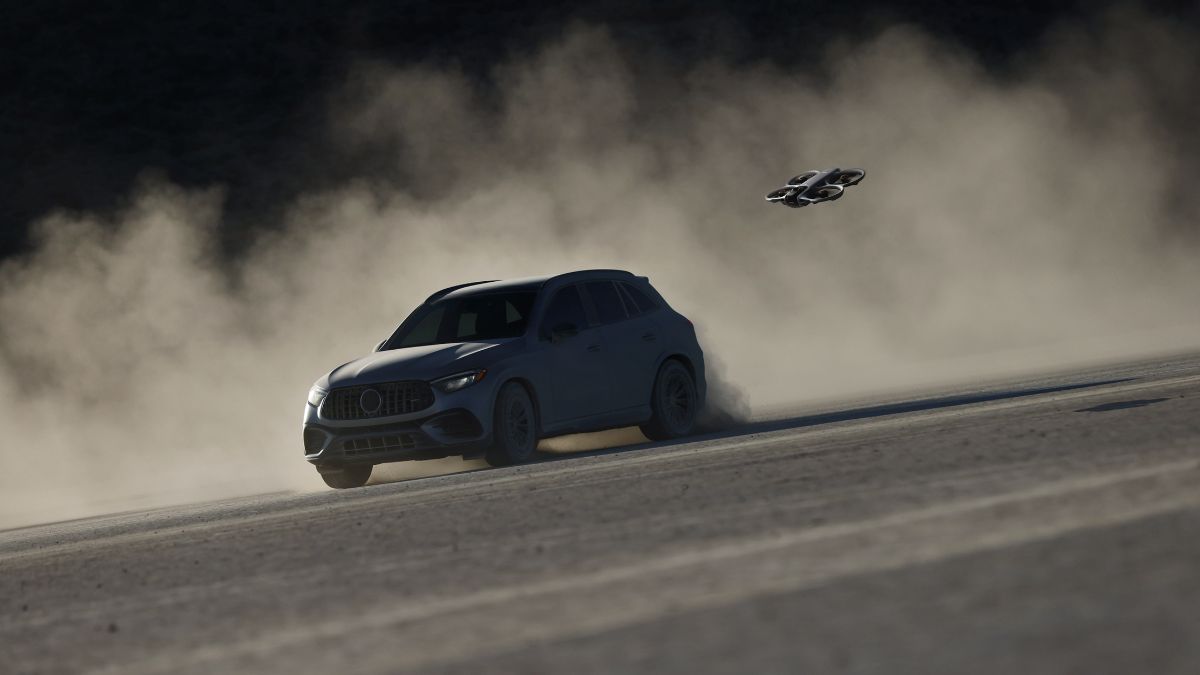
FPV opens shots a conventional aircraft cannot fly: continuous moves through interiors, dives that hold speed, and sequences that track action rather than observe it. It has become its own grammar rather than a novelty.
The DJI Avata 360 is the current flagship and changes how FPV fits a production. Dual 1/1.1-inch sensors capture a full spherical field at 8K, so a single pass yields multiple angles in the edit rather than one fixed framing. Virtual pans, rolls and look-backs are created in post, which means a complex move no longer has to be flown perfectly or risked at all. Omnidirectional obstacle sensing with LiDAR and a tiltable camera that switches between 360° and conventional forward FPV round it out.
The DJI Avata 2 remains in the range and is the better choice for tight interiors. At 377 g against the Avata 360's 455 g it is lighter and more agile through confined spaces, and it is the cheaper route into FPV for a production trying it for the first time. Both work with DJI Goggles 3 and N3, RC Motion 3 and the FPV Remote Controller 3.
For custom builds where a specific airframe or payload is required, the O4 Air Unit Series supports building around your own frame.
FPV footage is lower resolution and less flexible in the grade than an Inspire plate, and 360° capture trades per-angle resolution for coverage. It is a shot type rather than a substitute, and the productions that use it well plan for it in the edit rather than discovering it afterwards.
- Reframe in post from a single spherical pass rather than committing to one angle in the air
- Fly continuous moves through spaces a conventional aircraft cannot enter
- Track action at speed with a camera language distinct from crane or dolly work
- Choose the lighter Avata 2 where interior clearance matters more than resolution
- Build custom airframes around the O4 Air Unit where an off-the-shelf platform will not do
TRANSMISSION AND MONITORING
Getting the picture to the people who need it
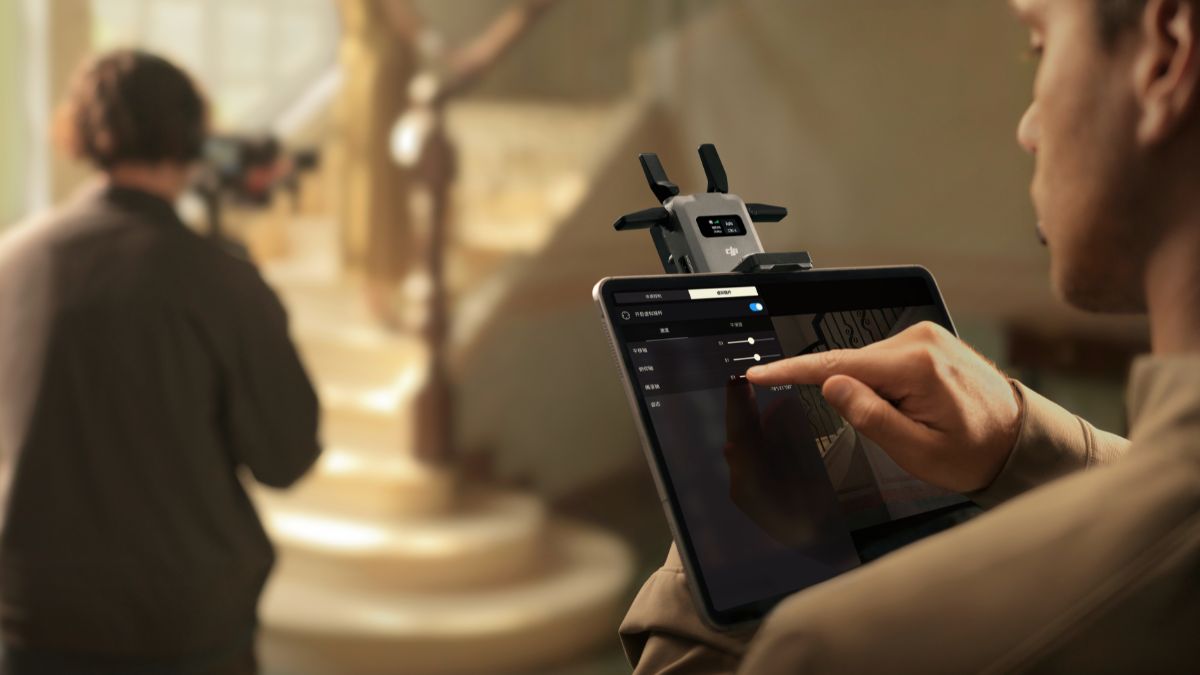
On a set, the shot is only useful if the director, the DoP, the script supervisor and the client can all see it. DJI Transmission and DJI SDR Transmission send video to monitors across a location, and with broadcast mode enabled through an RC Plus, an Inspire 3 feed reaches an unlimited number of remote monitors.
The DJI Mic 3 range covers production audio, and Osmo Action 6, Osmo Nano and Osmo 360 cover rigged, POV and immersive coverage where a full camera cannot be placed.
- Distribute the feed to monitors across a location without cabling every position
- Broadcast to unlimited monitors for large crews and client village
- Capture production audio through the Mic 3 range
- Rig action cameras where a cinema body physically will not fit
ON SET PRACTICALITIES
Four things that catch productions out
Aircraft are loud. A drone anywhere near a dialogue take will be on the track. Aerial units generally work around sound rather than alongside it, so the schedule needs to account for it and the sound department needs to know before the day rather than on it.
Weather takes days, not shots. Wind limits are real and rain grounds most platforms. On an exterior schedule with an aerial dependency, build a contingency day or plan a ground alternative for the shot.
Batteries set the rhythm. Aerial work runs in short takes with resets between, which is a different tempo from a crane that stays up. Factor the swap cycle into the day rather than assuming continuous availability.
Permissions are not a formality. Most professional aerial work sits outside the Open category and needs a GVC with an Operational Authorisation. Flying over people who are not under your control, over a congested area, or near controlled airspace each add a specific case to the CAA. A closed set with everyone briefed and under the operator's control is a materially different assessment from an open location, and the difference is worth understanding at the recce rather than at the gate.
Location filming also brings requirements that have nothing to do with the CAA. Local authority film permits, road closures, landowner consent and the production's own insurance all sit alongside the flight permissions, and they run on longer lead times than people expect.
Drone Solutions for Film and TV Operations
Enhance your filming capabilities with drone technology
CAPABILITIES
What a cinema platform has to deliver
Aerial units get one window, and the plate has to cut against everything else on the timeline. The specifications below are what determine whether it does.
Full-frame 8K capture
The X9-8K Air records 8K CinemaDNG through a full-frame sensor, giving a plate with the latitude to reframe, stabilise and grade in post.
Dual native ISO
Clean capture across bright and low light without a lighting rethink between setups, which matters when the window is a sunset rather than a schedule.
Interchangeable lenses
Five DL mount full-frame primes from 18 mm to telephoto, purpose built for aerial, the lightest at 178 g in a carbon fibre housing.
Colour matching air to ground
The DJI Cinema Color System matches the X9-8K Air to ground cameras including the Ronin 4D, so aerial plates cut against floor coverage without a grade fight.
Cinema-grade transmission
O3 Pro delivers long-range, low-latency transmission built for set conditions rather than open-field range claims.
Dual operator control
Pilot and gimbal operator work independently, and the gimbal operator can take the aircraft to land it if the pilot loses signal.
Extended gimbal range
360° pan and an 80° upward angle with the landing gear lowered, opening compositions a conventional gimbal cannot physically reach.
Repeatable moves
Saved waypoint routes fly the same move again for a second take, a plate pass or a VFX element.
Wide dynamic range
14+ stops on the X9, holding highlight and shadow through mixed and backlit conditions without bracketing.
WHO WE WORK WITH
Supplying UK production since 2015
Production companies, directors of photography, aerial operators, broadcasters, rental houses and independent filmmakers buy their equipment from us. We are a DJI Enterprise A-Rank retailer, DJI's highest authorised retail tier, and we run the largest indoor DJI store in the UK. We supply the equipment, train the crew that flies it, and repair it in house when something goes wrong.
WHY DRONE SAFE STORE
Support beyond the purchase
Choosing the right platform is only the beginning. We support your production from equipment selection and configuration through to training, rental, servicing and repair, all from our base in Chichester. We are a DJI Enterprise A-Rank retailer and ISO 9001 certified, and our showroom is the largest indoor DJI store in the UK, so you can build, handle and compare before you commit.
Accreditation
 Armed Forces Covenant
Proudly supporting the Armed Forces community and veterans.
Armed Forces Covenant
Proudly supporting the Armed Forces community and veterans.
 ISO 9001 Certified
Certified quality management systems for consistent service and customer satisfaction.
ISO 9001 Certified
Certified quality management systems for consistent service and customer satisfaction.
 DJI Enterprise A Rank Retailer
DJI's highest level of authorised retail and technical expertise.
DJI Enterprise A Rank Retailer
DJI's highest level of authorised retail and technical expertise.
 D-U-N-S® Registered
Globally recognised business identity, verified for international trade. Number: 221162020
D-U-N-S® Registered
Globally recognised business identity, verified for international trade. Number: 221162020
 Financial Conduct Authority
Authorised and regulated by the FCA for consumer finance activities.
Financial Conduct Authority
Authorised and regulated by the FCA for consumer finance activities.
 YPO Approved Supplier
Approved on the YPO framework as a supplier for Drones & Associated Services to help the Public Sector
YPO Approved Supplier
Approved on the YPO framework as a supplier for Drones & Associated Services to help the Public Sector
Get In Touch
Speak to Our Team
Speak to Our Film and Media Specialists Today